James and I qualified for our Nitrox certification this week.
Nitrox is air enriched with oxygen.

Scuba divers normally dive with compressed atmospheric air. This means it has a 21% oxygen content.
Now this is fine but one of the big risks in diving is posed by nitrogen. At depth it is dissolved from the air you breath into your blood. Where it can accumulate and form bubbles. In turn these bubbles can accumulate in joints or in your mussels.
These bubbles can cause a range of problems and can lead to decompression illness or the bends.
After drowning the bends is a diver’s biggest fear so much of what we do, the way we plan dives, surface intervals are all designed to reduce this risk. We ascend slowly and have safety stops to allow our bodies to purge of nitrogen.
However some remains in your system and over successive dives you accumulate residual nitrogen. This residual nitrogen has to be taken into account when planning subsequent dives and so places limits on what you can do, how deep you can go and how long you can stay down in order to minimise risk.
Nitrox offers a way to mitigate some of this risk and presents some real advantages over air for divers, ok so it poses a different set of risks but it’s a trade off and let’s face it we are diving which in of its self is pretty mad.
Nitrox is shorthand for oxygen enriched air.
Nitrox is any mix of air which has a greater percentage of oxygen than normal air e,g, 22%+ up to 40% oxygen.
The most common blend tends to be around 32% (a range from 30% to a little over 32%). Specialist divers and professionals use other mixes but recreational divers do not tend to.
By increasing the proportion of oxygen in your tank you reduces the nitrogen load your body takes and reduces absorption of the gas. As a result it means less recovery time on the surface between dives, longer time at depth* during repetitive dives and it also feels great, you feel less tired at the end of your dives.
* Recreational divers only go down to about 100ft. So here I am talking about 50ft to 100ft.
Greater depth, going below 100ft (120ft really) means additional training and special prep. As below 100ft there is the danger of oxygen toxicity which can cause convulsions and hallucinations. Not ideal. Increasing the proportion of oxygen with Nitrox ups this risk so it is not used bellow 100ft below in recreational diving. But above that it’s great!
Nitrox also changes what you can do in a dive day or when out on a boat.
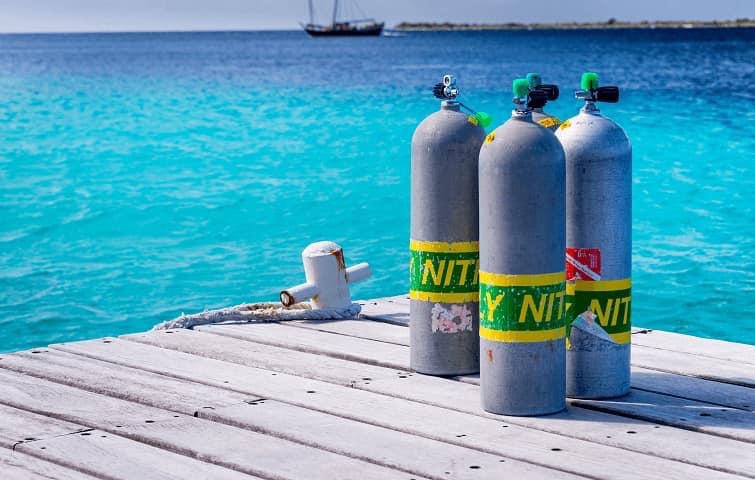
 Under an Endless Sky